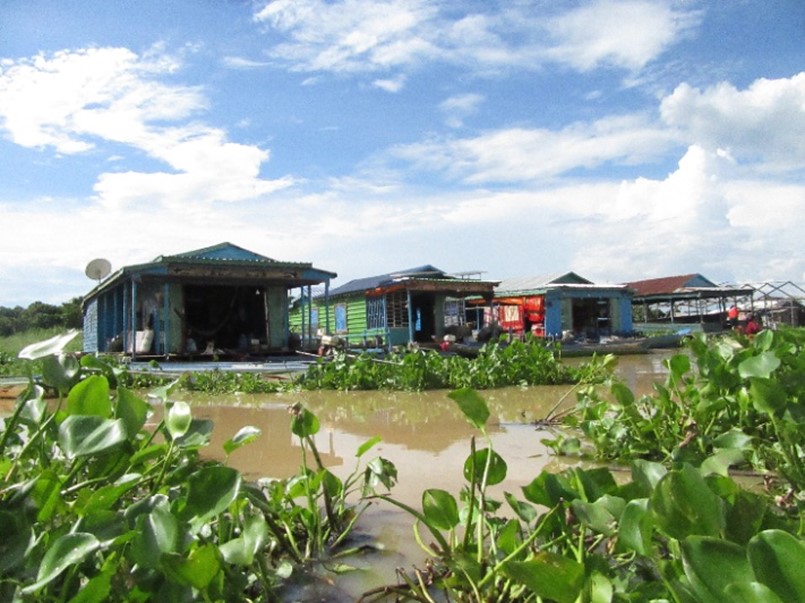
As the impact of marine plastics on the ecosystem has come to light, people have begun to realize that the durability of plastics, which is one of their good qualities, turns into a problem for the earth, as they are difficult to decompose when disposed of into the environment. Measures are being taken by those who use plastic, such as charging for plastic bags and restricting the use of plastic products by using alternatives, but the most important thing is to prevent plastic from being carelessly thrown away into the environment. There are many places around the world, especially in developing countries, where garbage collection and disposal is not carried out due to economic reasons. Since developing countries use large amounts of cheap and durable plastic, it is thought that the flow of plastic waste into the ocean will not be stopped unless measures are taken on the discharge side. Based on the idea that ``in areas where there is no garbage collection service and discarded plastic is likely to end up as marine plastic, there is a need to create a plastic waste separation and collection system that involves citizen participation'', we planned a project to promote the separation and collection of plastic waste among people living in floating communities on the shores of Tonle Sap Lake in Cambodia. There, people routinely dump trash into the water, and the lake water, which increases in volume during the rainy season, washes the trash downstream, with some of it flowing into the Pacific Ocean via the Tonle Sap and Mekong rivers. This project will proceed while forming a network with organizations such as the Cambodian Ministry of Environment, provincial offices, JICA offices, village communes, and private garbage recycling companies, with the Royal University of Phnom Penh in Cambodia as a counterpart.
Project period: 2022-04-08 to 2022-04-07 (2 years)
Business members/organizations:
→Business entity (Japanese side)
• Kenji Fujiwara, Jun Tsukiji,Habuer (Affiliated to the Graduate School of Environmental Life Sciences, Okayama
University)
• Kazuo Shibuya, Kaori Fujita (Japan International Cooperation Agency
(JICA) China Center)
→Business cooperation (local side)
• Vin Spoann, Phat Chandara (Counterpart: Royal University of Phnom Penh)
• Noriko Ogawa, Yoshiko Watanabe (Japan International Cooperation Agency
(JICA) Cambodia Office)